We tried something new (for us) this year, and had an Ignite session during the Taylor Institute’s annual conference. It was a risk, as we had never hosted that format before, and none of the 6 presenters (for 5 presentations) had ever done an Ignite. Nevertheless, we persisted.
I got talked into being the (humble) host for the event, introducing the format and acting as emcee between presenters. Each presenter provided their slides earlier in the week, so I had time to smush them all into one master presentation file and apply the automatic slide progression for their decks.
The push for educational technology exists within a broader political, economic, ideological, and technological context. The all-too-common ignorance of this context and the subtleties of learning itself may prove problematic for edtech — and higher education’s future.
The article is a really good one, and points to the broad issues with the disruption-of-education-by-silicon-valley narrative (one which has been championed by Audrey Watters for years, and which also overlaps with the work that Stephen Downes has been doing forever).
We’ve been in the Taylor Institute for Teaching and Learning’s new building for almost a year now, and it’s time to step back and reflect on what we’ve learned through that first year.
The building itself is a marvel of architecture, design and technology. We’re extremely fortunate to be able to go to work there every day. It’s been a constant source of inspiration - not the building, but the amazing things that instructors, students and staff are doing within it, together, on a regular basis.
I’ve been struggling with this, as I’m sure most people are. It hit me last night (again), when I was essentially numb as I tried to tune out the insanity from Trump’s speech to Congress.
I try to assume everyone is trying to do the right thing, in their own way, from their own perspective. Even Trump. He’s a scared little man, used to entitlement and getting his way. From that perspective, he’s just trying to use his awesomeness to save the world from lesser men. Yikes.
The muslim ban executive order was a wakeup call. It’s now a different world, and we need to take the time to think through what the implications are.
Personally, I’d probably be largely unaffected. I’m a middle-aged white male with no visible signs of dissent. Well. I have a beard. But I could probably continue travelling to the US without much trouble.
But. I work with people who would be directly challenged by this. And there are students in the computer science lab I’m part of who would be forbidden from entering the US. Which is ridiculous. But it’s a serious problem - academia is strongly based on the conference model - travel to a place, present your research and make connections with other people doing similar research. It’s how things are done.
I’ve been thinking about doing this since the last US election. And now, with the words and actions of the Trump administration, I’m just not comfortable leaving my web presence on US servers.
The decision to move my stuff back onto Canadian servers was easy - just a simple exercise in logic. The hard part is leaving what has been the best web hosting company - the best online community supporter - I’ve ever had the pleasure of being a member of. ReclaimHosting (nee Hippie Hosting Co-op) is the best web hosting provider I’ve ever come into contact with. Great company. Even better people. A pleasure to work with on any level.
Our annual conference is coming up quickly - the call for proposals is open now (closing Feb 3, 2017 - less than a month away!). This is one of the things I’m most proud about. This conference has grown from a small, mostly-internal thing, to an incredible and deep conference with an amazing community vibe. It’s now drawing participants and presenters from across Canada, and has a surprising number of international participants as well. This has become my one must-go-to event each year (which is handy, considering I work in the building and help to organize and run it) - and I would easily rank it as one of the top conference experiences I’ve ever had.
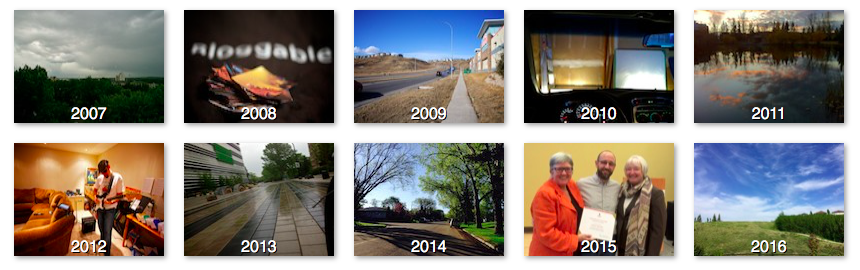
I just pulled together photos from each day of 2016 - and realized I’ve been shooting at least one photo per day for a decade now. I didn’t think I’d be able to keep doing it, but now can’t imagine not doing it.
The latest gallery has 366 photos, due to the leap year. My photos have gone through artsy phases, and have pretty much settled into an informal documentary style. Lots of repeating shots over the years. Lots of progress shots - of people and places. This was the year of building the Taylor Institute for Teaching and Learning, installing a bunch of tech, and moving in. So, lots of photos of that.
One of the things I’d come to depend on when using FeverËš was a hand-rolled PHP utility script (cleverly called “Readinator”) that grabbed all feed items that I’d starred in FeverËš in the last week and generated a list in Markdown syntax for easy copy/paste into my Week in Review™ posts (it also pulls links that I’ve added to my Scuttle bookmark server in the last week as well). After moving to Newsblur, my utility script obviously became less useful. Sadface.
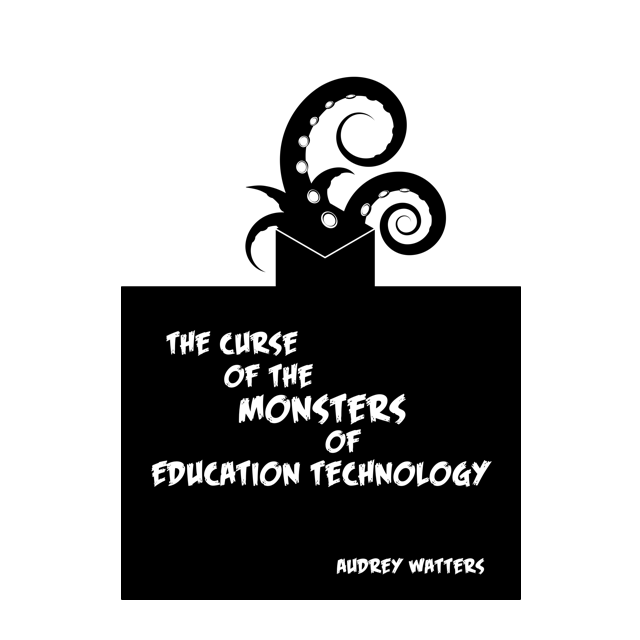
Audrey Watters’ third annual edtech book publishing spree brings us The Curse of the Monsters of Education Technology - a compilation of her keynote addresses from 2016. As with the previous two, it will be a must-read. Given how dark and dismal 2016 was, even/especially in edtech…
Once again, I spent much of 2016 on the road, traveling and speaking extensively about education technology’s histories, ideologies, and mythologies. The Curse of the Monsters of Education Technology is a collection of about a dozen of those talks on topics ranging from pigeons to predicting the future.
I’ve lived with RSS as a major source of information for over a decade. I’ve been using Shaun Inman’s fantastic FeverËš self-hosted reader since 2009 or so. It’s been a solid workhorse, and I’ve built quite a workflow around it. Shaun is refocusing his efforts on software that he uses himself, and is putting FeverËš and Mint out to pasture. That’s a hard decision to make, and I admire him for making it. Since FeverËš is self-hosted, I could just keep using it until it eventually crumbles (as PHP updates around it, etc.) but I’m taking this opportunity to take a look at how I manage my feeds.
Having done the delete-social-media-account dance again, I’m without Twitter and Facebook. And still feeling really really good about that. But, I miss being part of an extended community of interesting people who share ideas quasi-synchronously. A social network, as it were.
So. I’ve been looking at some of the alternatives. I don’t think any of them are “there” yet, but they each provide an opportunity to explore different aspects of community and software design. When looking at these alternatives, I’m trying to learn about how the design of software affects what people actually do with it. I’m also aware that much of the difference, when compared with twitter or facebook, is due to novelty and freshness - there are no trolls there (yet), and everyone who is exploring the platforms is doing so because they care and are interested and interesting. So, not apples-to-apples. But, still, there is much to learn by actually using these things. That’s the only way I know of to really learn what these things mean.