This is an important project, led by my team in the Taylor Institute (go, Ykje and Samara!). We’re all looking forward to seeing what the grant recipients come up with this year.
OER grants fall under two streams: “adopt and adapt” and “create.” The former category consists of projects in which grant-holders redevelop existing materials for their OERs, whereas the latter involves the inception of an OER from the foundation up.
The OER Pilot has invited instructors to submit project proposals. In the adopt and adapt model, accepted projects are funded to allow for two undergraduate student researchers to apply two to three online resources with course- and lesson-based outcomes. At the same time, instructors employ graduate students to peer review resources for their project courses. Finally, faculty selects and decides on the most appropriate resource.
… 2017-18 OER Grant Recipients
Sharaz Khan, Haskayne School of Business “Business technology management (BMTA 601)
Nicole Sandblom, Faculty of Science “General chemistry for engineers” (CHEM 209)
Joanna Rankin, Cumming School of Medicine “Introduction to disability and social theory” (CORE 209)
Elena Rangelova, Schulich School of Engineering “Fundamentals of surveying” (ENGO 343)
Mayi Arcellana-Panlilio, Cumming School of Medicine “Honours cell & molecular biology” (MDSC 351)
Maria Stoletova, Haskayne School of Business “Business process improvement and creative problem solving” (MGST 741)
Jason Donev, Faculty of Science “Introduction to energy” (PHYS 371)
Kathleen Hughes, Faculty of Arts “Cognitive development” (PSYCH 451)
I’m hoping to add a grad or senior undergrad student to the Learning Technologies Group. This position will work closely with other members of the team, and will get to work directly with instructors who are teaching face-to-face, blended, or online courses as they integrate various learning technologies. Like consulting and collaborating with instructors who are doing cool things in their courses? Like working with people from all 13 faculties and with people in key departments across campus (including, of course, the Taylor Institute for Teaching and Learning, Information Technologies, and Libraries and Cultural Resources)?
Open Classroom Week is one of the programs that have grown over the last few years - instructors volunteer to open their classrooms to other instructors to come and observe how they teach, so they can see different kinds of learning activities and teaching strategies in practice.
As its name suggests, Open Classroom Week (OCW) is all about openness. By allowing instructors to observe and be observed by one another in active classroom environments, this event presents participants with the opportunity to engage with, and learn from, one another’s classroom strategies, disciplinary specialties and technological teaching applications. At the end of Open Classroom Week, both observed instructors and observers gather for a themed conversation that encourages reflection and cross-faculty insight.
I’ve been uneasy with the role that social media has in my life for a long time. One part information, one part connection with friends and colleagues, one part numbing, one part noise and abuse and racism and sexism. I don’t know a healthy way to approach social media. I don’t believe there is one. The concept is attractive - instant connection with people I know and love! Who wouldn’t want THAT? But it comes with so much other toxic garbage that it feels like forcing myself to wade through an endless cesspool in order to catch glimpses of those people who are important to me.
I wonder, how has the monetize-attention-with-targeted-ads environment we’ve wound up in changed how we perceive the world and events around us. If the ISS blew up, it’d be big news, but only until the president tweeted something, or some giant company was caught doing something stupid. Or some president tweeted something stupid. News of major events used to bring people together. Physically. I remember watching updates from the original Gulf War, on TVs in hallways on campus. People - students, profs, staff - gathered around, paused together, before moving on and returning later. Now, we glance at a phone, nod, and repeat. It started with the 24-hour news cycle, which really came to become a real thing during that first Gulf War, and has now grown to become endless, individualized, targeted and hyper-tribalized news feeds, optimized not for communication or information, but for maximizing advertising revenue.
I’m taking a graduate computer science course on information visualization. It’s going to be an incredible experience, exploring how to make sense of data sets and use spatial/symbolic/textural/other means to represent various aspects of the data.
A huge part of the course is going to be keeping a daily “visual journal” of things we see, as they relate to information and visualization and design. Sounds something like a photoblog. So, I volunteered to set up a class blog for us all to post stuff together, to see what happens. Of course, I’m using UCalgaryBlogs. WordPress is pretty good for this kind of thing. I’m using the Baskerville theme because it’s nicely visual - almost pinterest-y. And, a few plugins:
I haven’t said anything publicly about this yet, because I wanted to make sure certain people weren’t surprised by internet news without hearing it from me first. I wasn’t going to blog this, but that feels… inconsistent? I’ve been blogging milestones and stuff for 15 years now, and it feels weird to not blog this. So.
First, this is going to sound scary. It’s not. (well, mostly.) I’m fine, and will be for a long, long time.
This post started as a tweet (which I deleted before posting), and then a series of tweets (which I only wrote in my head but never actually posted). Then, hey! I have a blog! So… I’m not going to fully (even partially? at all?) cite references here.
I’ve been uncomfortable with the “education is a broadcast model” narrative that’s been predominant for the last decade(s). It’s making another round, likely fueled by pushback against DeVos in the states (which, yikes!) and some NYTimes articles about billionaires who have ideas to fix education, if we just give them our kids (but mostly our money).
We threw the switch this morning, launching the OER pilot program. It’s a small-scale initiative, intended to support the integration of open textbooks into 10 courses within the 2017/2018 academic year. There are two branches - faculty advocacy, and project implementation. The implementation is being let by my team at the Taylor Institute, working with the University of Calgary’s OER Faculty Advocate and his team.
We’ll be hiring a graduate student to act as a research assistant for the program, who will help coordinate the various projects - hopefully 10 concurrent projects with instructors working with up to 20 undergraduate students to identify good candidate resources for use in a course, which will be reviewed by a graduate student (and the instructor) before being integrated into the course.
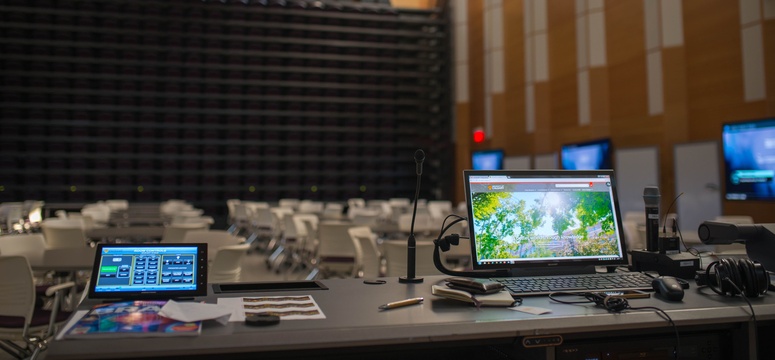
The Taylor Institute’s AV systems were designed to be incredibly flexible, able to adapt to changing requirements between (or even during) classes. That meant shifting from hardwired analog systems to fully digital media management to allow for software-controlled mixing and switching of signals.
What people assume, when they walk into a classroom, is something basically like this:
You show up, plug your laptop in, and it sends stuff to the projector. And other stuff to the speakers. Simple.
Dr. Märtensson’s research formed much of the foundation of the plan for the Taylor Institute. Specifically, the macro/meso/micro layers within an organization, and working with each layer in various ways to draw people into the community. Her keynote at the 2017 University of Calgary Conference on Post-secondary Learning and Teaching was great, and nicely connected many of the threads of the conference.