We’ve been adapting to life in a shared, open workspace environment. Most of us in the Taylor Institute are in pods, trying to balance productivity, collaboration, distractions, competing demands for attention. It’s hard to describe what it’s like, but it adds overhead on top of everything. Quincy describes it well, from the perspective of s programmer, but I think it applies to the rest of us as well.
Let’s talk a bit about how us humans get work done. Is it four hours of crushing it, a lunch break, then four more hours of crushing it? No. It’s more like coffee, email, coffee, meeting, coffee, lunch with coworkers, coffee — OK finally time to get some work done!
I don’t think of AI as trying to invent an artificial human, but it’s extremely important to think about the cultural, moral, racial, and gender biases that get baked into code through histories of projects.
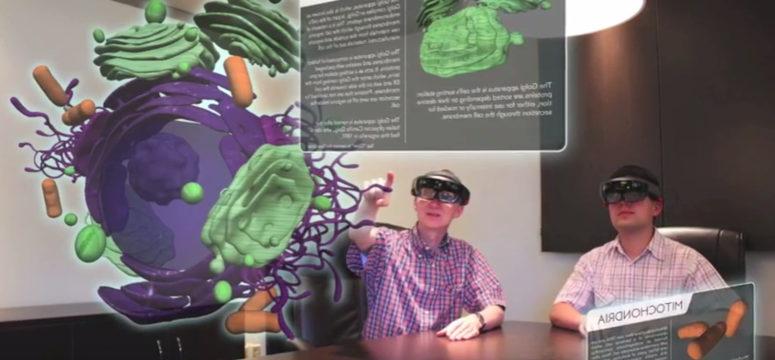
This is cool. Christian’s lab has been producing some amazing tech for visualizing and interacting with human and cellular anatomy, including LINDSAY Virtual Human, and now this:
Christian Jacob and Markus Santoso are trying to re-create the experience of the aforementioned agents in Fantastic Voyage. Working with 3D modelling company Zygote, they and recent MSc graduate Douglas Yuen have created HoloCell, an educational software. Using Microsoft’s revolutionary HoloLens AR glasses, HoloCell provides a mixed reality experience allowing users to explore a 3D simulation of the inner workings, organelles, and molecules of a healthy human cell.Jacob has plenty of experience in bioinformatics as the head of the Lindsay Virtual Human Project.
He’s taught courses in a similar way in regular classrooms using workarounds to deal with obstacles such stationary chairs and more rudimentary technology. “You can do this in just about any classroom, you just need enough imagination,” he says, adding one stipulation: “If I had a banked lecture hall, this would not work.”
I’m in the third week of a PhD program, and have had to make some adjustments to how I do things in order to be able to concentrate and actually think. I was struck by my inability to read a full paragraph without switching over to check email/calendar/twitter/slack/facebook/whatever. Mostly email and twitter.
I’m basically living in digital content - everything I do is in OneNote and Outlook, synced to every device I use. My email and calendar basically organize my day. There are people in there.
Stephen Downes points to some new regulations that may require people (celebrities and others) to declare when something they’re posting has been sponsored by a third party. He also suggests (rightly) that edubloggers and pundits should have similar declarations, to point out any possible conflicts of interest or bias.
Not that I expect any major change, but it would be interesting to see all education and technology pundits declare their sponsorships and affiliations. “The new rules, expected to be implemented by early 2017, will require such individuals to disclose whether they’ve received payment — either in the form of cash, free products or other considerations — in exchange for the mention. Bloggers will need to include statements within their posts or videos while users of social media platforms such as Twitter, Instagram and Snapchat will have to include hashtags such as #sponsored, #spon or #ad.”
Wordfence automatically blocks IP addresses that repeatedly attempt to brute-force logins on UCalgaryBlogs. After a few attempts, they aren’t able to try again for a few minutes (in case it’s a legitimate person trying to log in, it doesn’t banish them entirely right away). If they knock it off, the ban gets lifted. If they keep hammering, the ban gets escalated, eventually putting them in a permanent penalty box (identified by their IP address - not perfect, but it’s all we have).
Alec Couros posted a quick throwaway on Facebook (I’d link to it, but Facebook doesn’t work that way)
It got a lot of likes, and then the comment thread kind of exploded. I posted several comments and replies, and realized that was a silly way to post that particular discussion because it’s exactly the kind of thing we are talking about as killing blogging and personal publishing.
A great summary of various bits of tech that made the early blogosphere1 so alive and vibrant in ways that hasn’t been captured or reproduced since. How can tools give individuals control over what they create, where they publish, who they follow, what they read, and how they share? These are currently controlled almost exclusively by one of two companies for the majority people on the modern internet. Something amazing, powerful, and enabling was lost in that transition.
You hear a lot of talk about information overload, but I don’t feel the amount of information is the problem. For me, the problem comes in with the emotional investment demanded by real-time, and the ultimate toll it can take on your productivity, or just general happiness and well-being. You can see this play out in everything from expectations that you should respond to emails, all the way to social network memes getting your attention when it comes to the election, or for me personally, the concerns around security and privacy using technology.
These comments were started in response to a friend, who was taking a stand against Facebook and their take-it-or-leave-it end user license agreement (EULA). They’re not the most profound comments, nor the most well-crafted, but I think they need to exist (also) outside of Facebook’s corporate walled garden. Ironically, after I posted the first comment, the Facebook iPad app prompted me to take a survey about how (un)comfortable I was with the state of Facebook, with specific questions asking about the algorithmic feed. So, I filled it in to indicate that I am very (VERY) uncomfortable with the algorithmic news feed…
The Taylor Institute has 5 learning studios, designed for active and collaborative learning. People who are using the space have access to some great technology to support their work, including 37 “collaboration stations” (we really need to come up with a better name for those…).
Here’s a quick-ish demo of the basic functionality provided by the stations, recorded using the lecture capture system built into the learning studios.


 These comments were started in response to a friend, who was taking a stand against Facebook and their take-it-or-leave-it end user license agreement (EULA). They’re not the most profound comments, nor the most well-crafted, but I think they need to exist (also) outside of Facebook’s corporate walled garden. Ironically, after I posted the first comment, the Facebook iPad app prompted me to take a survey about how (un)comfortable I was with the state of Facebook, with specific questions asking about the algorithmic feed. So, I filled it in to indicate that I am very (VERY) uncomfortable with the algorithmic news feed…