Another in a series of really great articles in the Times, about cancer and dying. Fun topics that are kind of relevant.
“The most obvious” response, wrote the neurosurgeon Paul Kalanithi in “When Breath Becomes Air,” his memoir of a brilliant life cut short, “might be an impulse to frantic activity: to live life to the fullest, to travel, to dine, to achieve a host of neglected ambitions.” But cancer limits the energy for compacted living, and a longer view takes hold. “Money, status, all the vanities the preacher of Ecclesiastes described hold so little interest; a chasing after wind, indeed.”
A study cited in the paper notes publisher websites utilize an average of 13.5 (and up to 70 in some cases) third parties. A visit to one popular U.S. tabloid triggered a user interaction with some 352 other web servers, according to a 2014 U.S. Senate subcommittee study of the issue.
Many of those interactions were benign; however, some of those third parties may have been using cookies or other technology to compile data on consumers without their explicit consent, according to the study. Data mined by the practice can include users’ interests, browsing history, location, and past-purchase history.
For some reason, I felt like turning my blog into something reminiscent of Hypercard. Maybe it’s nostalgia? Maybe it’s a throwback to an era from before the web? Maybe it’s an ironic attempt to de-emphasize design over content? Maybe all of those.
Anyway. I found this great Chicago-inspired webfont, released under a Creative Commons license by Giles Booth. At first, I just used a local stylesheet to force it to be used on any site, but then I realized I wanted it running on my blog full-time. But I didn’t want to have to create a new theme to do it. So, a plugin!
…blogging either needs its own mechanisms of ambient humanity — which it’s had, in the form of links, trackbacks, conversations, even (gulp) comments, all of which replicated at least a fraction of the buzz that social media has — or it needs a kind of escape velocity to break that gravitational pull. Gravity or speed. Or a hybrid of both.
Arizona is an amazing place. Driving south from Strawberry, we passed through about a dozen distinct biomes, and ended up in a landscape that would be at home in a Wile E. Coyote cartoon.
The drive left some quality time for mobile playlisting…
And winding up in Winslow, arizona, where it appeared as though we formed a Conga line of tourists waiting to be photographed next to a statue commemorating some obscure song by a no-name indie band.
For my PhD research, I’ve been bouncing ideas around for how to volumetrically capture a performance or classroom session in 3D, and then layer on additional contextual data (interactions between participants, connections, info from dramaturgy, info from SoTL, etc.).
This NEBULA experimental jazz video by Marcin Nowrotek kind of gets at some of what’s in my head. Imagine this, showing a group of students collaborating in an active learning session, and instead of notes/percussion visualizations, some kind of representation of how they are interacting etc… Also, since it’s all in 3D, imagine being able to interact with the recording in 3D using fancy goggles.
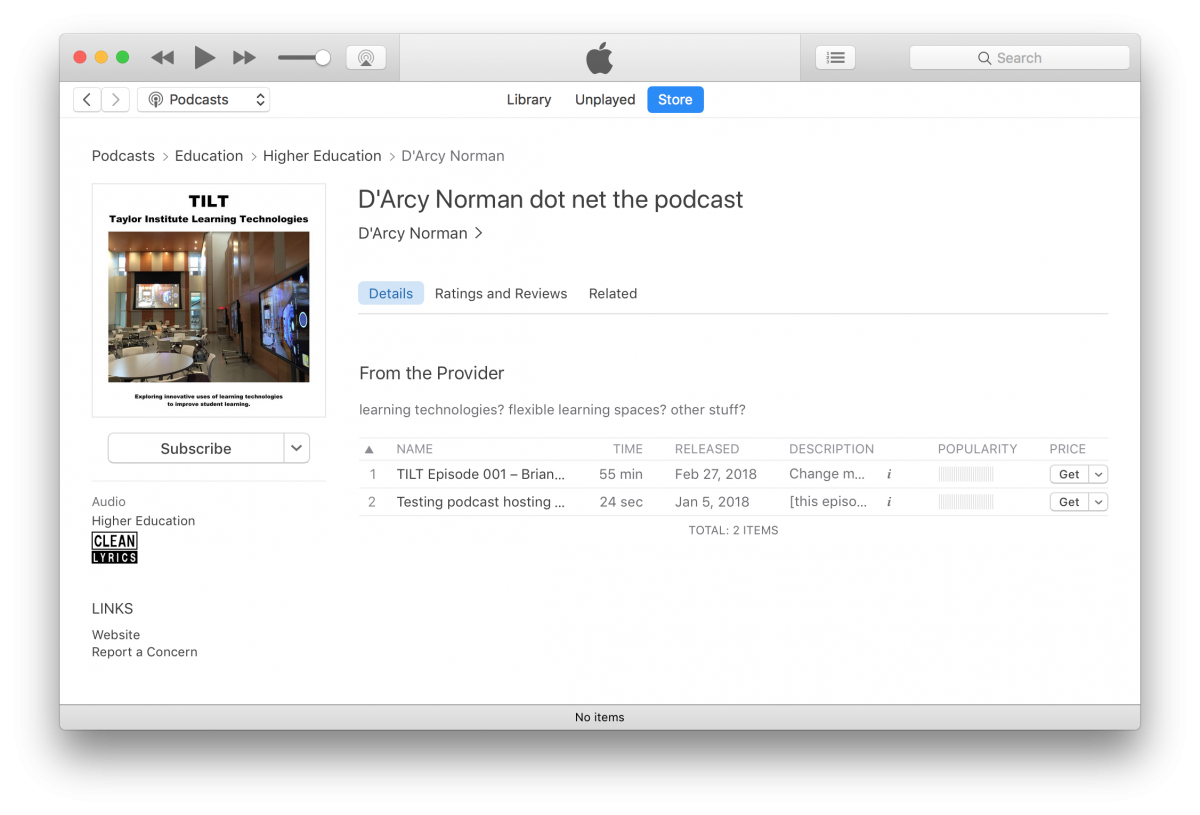
I hadn’t published a podcast since 2005, back when podcasting meant “automating downloads of audio files to an iPod because there’s no internet connection when you’re mobile” and not “any kind of media, and nobody even remembers what an iPod is anymore, and why on earth wouldn’t you have an internet connection all the time?”
Anyway. I’d assumed the passing decade would have meant audio production tools and podcast publication tools would have matured significantly since the good old days. Nope. Audio editing still basically sucks. Audacity works, but is destructive and fussy and a pain sometimes. GarageBand is so horribly designed for actually editing audio that it’s worse than Audacity. There are other editing tools, but they all seem to suck in various ways. Where’s the simple, non-destructive, easy audio editing tool that lets you remove noise and make the audio sound good? iMovie does it well for video. Where’s the audio version of that? I want my hovercraft.
We’re getting ready to roll out the new “Daylight” interface for D2L, which will go live on May 4, 2018. The biggest benefit is a responsive design, which will make the experience on mobile devices much, much better. And, it will also make it more usable through screen readers and other accessibility devices. Also, it’s very shiny.
The Pilot Project was announced in March 2017 at UCalgary Open Education Week, with the call for proposals being released in July 2017. Workshops were held for academic staff interested in obtaining an OER grant. In late August 2017, the UCalgary OER research assistant was hired and committee met and decided on the ten pilot project grant recipients. A list of the recipients and details of their projects can be found here. The project runs until June 30, 2018.
Well, mostly. I’ve been mostly without Twitter for a couple of months now. I haven’t had a Facebook account for much longer than that. I stopped Instagramming when Facebook bought them. I’ve deleted the Twitter apps from my devices, and now if I want to check in I have to use the browser. Not having notifications or easy launching of a stream adds a bit of friction. I also have 2-factor authentication enabled, and logout after checking in, so dropping into twitter is deliberately kind of a pain in the ass. I only post to Twitter via auto-tweeting from my blog when I post here.
Wiki.ucalgary.ca is the longest-running learning technology platform at the University of Calgary - I launched it back in December 2004, and it’s been chugging along for over 13 years. It’s a teenager. Generations old, in internet time.
It started with a blank copy of Mediawiki, and an edit button. Over 13 years, 1,871 pages were created (for everything from faculties and departments, to collaboratively published articles for student projects to resources for organizing courses and programs). 71,393 edits were made (many of those were reverting spam attacks, however).