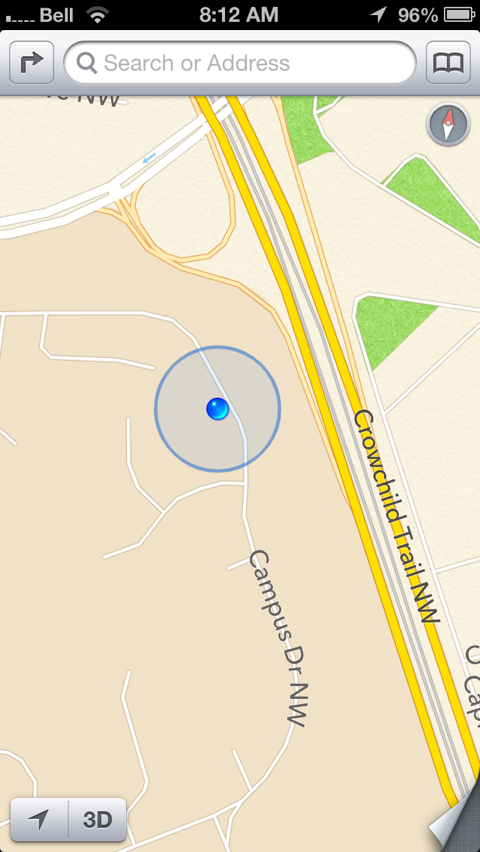
A quick test, to compare Apple’s Maps app from iOS6 with the new Google Maps iOS app that was released today. All screenshots are roughly centred on the same spot around my office on the UofC campus, taken on a godphone 5.
normal map view. Apple iOS Maps on left, Google iOS Maps on right…
satellite view, Apple iOS Maps on left, Google iOS Maps on right…
Over 60,000 in one course. This will change everything! Except for the part about needing the same effective class size in order to support the handful of students that actually pass the course… Nice reorganization of the marketing hype published by Coursera.
So in the end, we have 107 students who got the more personalized attention (doing a project, getting feedback, being part of the Google hangout presentations).
This class had one professor and 3 TA, about a 1 : 27 teacher/student ratio.
I don’t usually have to put an explicit disclaimer on posts, but here goes. I’m not writing this in any official capacity, my university hasn’t approved the message. YMMV. IANAL. YHBH. etc…
I was at a presentation by Dr. Krishnaswamy Nandakumar on the impact of technology in education, and it triggered some thoughts on MOOCs1. I’d been avoiding thinking (or writing) about them, because the hype just seemed silly and pointless. But, combined by a recent nudge by Kate Bowles, I think it’s worth writing it now.
Giving people access to didactic lectures by a handful of elite professors at a handful of elite institutions is not the most important educational technology in the last 200 years. Not even close. Sure, it’s good. It’s fantastic that I can have access to the lectures and resources of some of the biggest and most famous institutions. Awesome.
But the most important ed tech in two centuries? Bull. Shit.
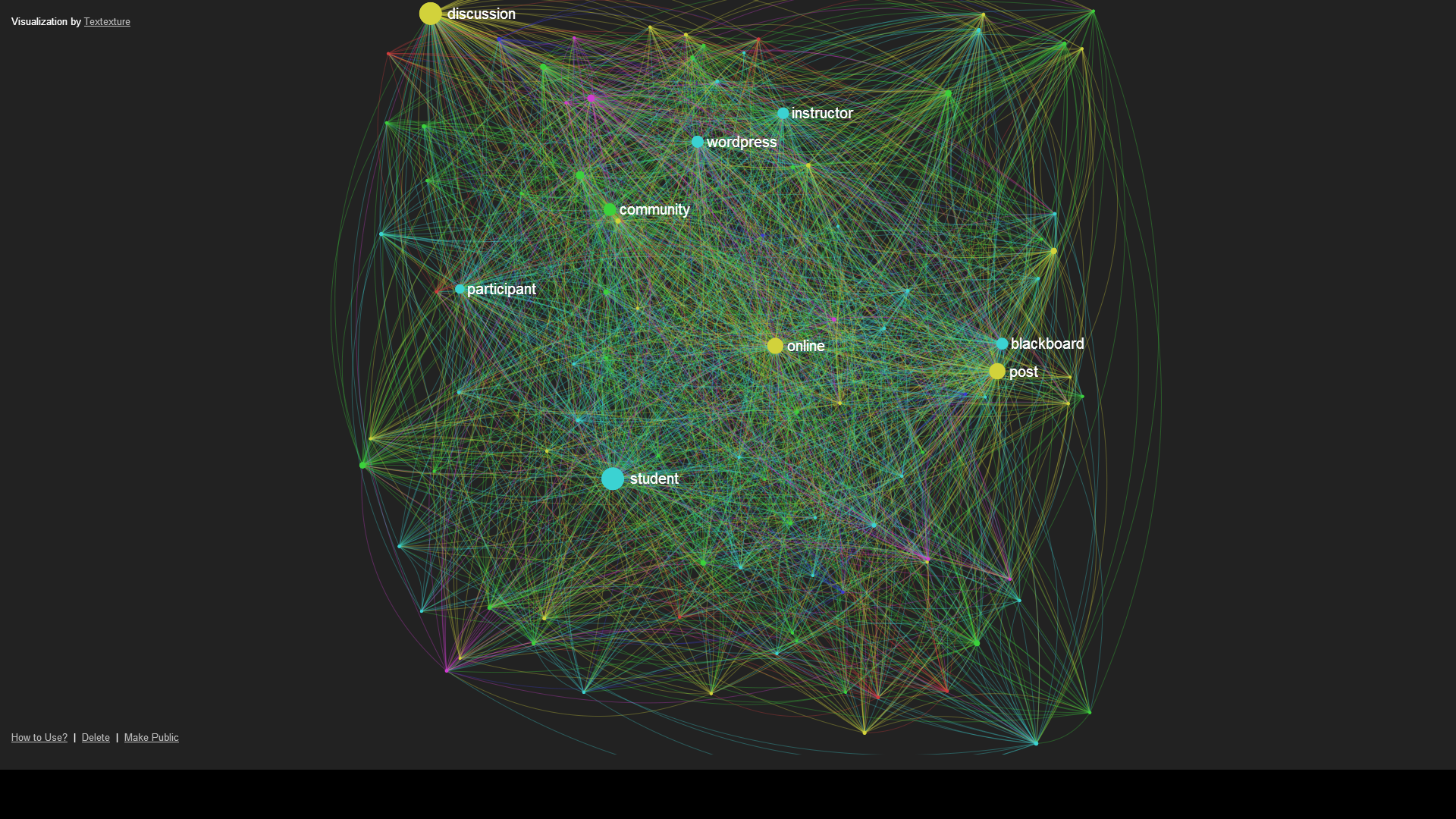
using textexture.com, thanks to a tip from Bryan Alexander. Doesn’t mean a whole lot at first glance, but it sure is purty. This is chapters 4 and 5 of my thesis (textexture choked on the whole thing):
I’m almost done. About a month to oral defence. But, here are the tools I used to gather data, process it, whip up visualizations, and write the thesis:
Papers (for storing the 598 papers I worked through during the process).12
Dropbox (for having the files available on any computer I’m using, storing revisions, and making me not freak out about backups)3
Noteshelf - best notebook iPad app I’ve used. Did CoI coding data in it. Tracked progress in it. Sketched visualization ideas in it. Etc…
SurveyMonkey (for the online survey. wish I hadn’t used it, though, because I didn’t spring for a paid license and my data was trapped)
a custom HTML page and CGI processor hosted by UCalgary for gathering ethics consent from participants
Chrome (save web page… provided the online discussion archives)
So it looks like Pearson sent a DMCA takedown notice to edublogs and their hosting provider. And edublogs’ hosting provider crumbled and took down 1.4 million websites in response.
To be clear, Pearson didn’t take anything down. I’m guessing a legal intern or bot followed an algorithm (search for known strings, run a Whois, send email…). And the hosting provider, who should have told the legal intern to frack off and take their silly misguided takedown requests with them, decided to turn off websites rather than having to risk paying their own lawyers to fight the request.
John sent this around. It’s too awesome not to post.
yeah. my commute isn’t quite like that…
but, with all of the awesome trick riding in the video, I was most stunned by the application of WD-40 at the end of the video. I mean, WHO DOES THAT? It’s a solvent. No est bueno!
I just tried out the new PrivacyFix extension, which checks your privacy settings and also estimates how much Facebook and Google make off me each year.
Turns out, my privacy settings are pretty decent already. And, it looks like Google makes less than a dollar per year off me. Facebook makes nothing. The guy that wrote the article on Ars Technica clocks in at $700 per year going to Google, through advertising etc… Wow.