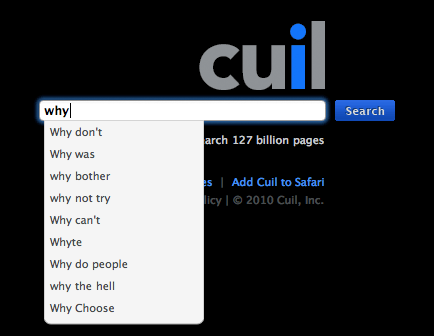
why

good questions, indeed…
other search engines take a stab at the meaning of life:



 Read More
good questions, indeed…
other search engines take a stab at the meaning of life:
Read MoreIn Medium Raw, Bourdain describes the thoughts he had, transitioning from a coke-head heroin addict to a doting father, and how the panopticon (he didn’t call it that, though) played a role in the process:
Read More
The iniquitousness of Twitter and food- and chef-related Web sites and blogs has totally changed the game for anyone with a television show - even me. You don’t have to be very famous at all these days to end up with a blurry photograph on DumbAssCelebrities.com. You don’t want your daughter’s little schoolmates reading about her daddy, stuttering drunk, two o’clock in the morning, at a chef-friendly bar, doing belly shots from a chunky and underdressed cocktail waitress – something that could well have happened a few years ago. In a day when a passing cell-phone user can easily get a surreptitious photo of you, slinking out of the porn shop with copies of Anal Rampage 2 and MILFBusters under your arm, and post it in real time, maybe that’s a particularly good time to trade in the leather jacket for some cotton Dockers.
With journalism being neutered in favour of fluff pieces like cat fashion and covering the latest reality tv shows, there is a real danger. If real professionals aren’t left in the newsrooms, who will be asking the tough questions?
From an interview with climate scientist Stephen Schneider:
> The reason that we do not ask focus groups of farmers and auto workers to determine how to license airplane pilots and doctors is they have no skill at that. And we do not ask people with PhDs who are not climatologists to tell us whether climate science is right or wrong, because they have no skill at that, particularly when they’re hired by the fossil-fuel industry because of their PhDs to cast doubt. So here is where balance is actually false reporting.
>
>What the media needs to do is not to ignore outliers—we should never ignore outliers—[but] to frame where they sit in the spectrum of knowledgeable opinion. The good reporters always did that. They said, ‘There are a small number of people, many of whom are funded by particular industries, who make the following point.’ That’s completely legit, because now the public knows where these guys sit.
>
>But now, given the new media business-driven model, where they fired most specialists and the only people left in the newsroom are general-assignment reporters who have to do a grown-up’s job, how are they going to be able to discern the north end of a southbound horse?
I just found a (new?) project listed in our TLC timesheets system. I think I have a new favourite project…
 Read More
This post has been percolating for a while, but was finally pulled out by a post from Stephen Downes, linking to a post from Lisa Nielsen.
Most of the blogs set up on UCalgaryBlogs aren’t fully public - many allow anyone to see the content, but block search engines. But, many others are restricted to only allowing members of that site to access the content.
Initially, this bothered me. People weren’t seeing the Power of Being Open. I tried arguing the whole “information wants to be free” and “going public with network effects” etc… yaddayadda.
Read MoreI’ve been playing around in Ubuntu Server for the last couple of days, setting up a test sandbox of WordPress 3 to safely try upgrading UCalgaryBlogs. I’ve used Ubuntu before, but it’s really feeling like a solid system, and the LAMP stack is fast. I’m only running it in a VM under VirtualBox on my desktop, but if I had to deploy a fresh server, I’d definitely be picking Ubuntu to run it. As a virtualized sandbox, it’s a pretty great platform. And the ease of updating/configuring is pretty slick. Certainly more nimble than RHEL5…
Read MoreI’m toying around with building a fresh copy of PHP so I can run a relatively recent version (5.3.2) vs. the antique version bundled with RHEL5 (5.1.6). Having lots of fun, so far…

Sometimes, it’s worth running your own server, so you can do things like update packages without having to resort to compiling from source…
Read MoreI launched MS Word to read a file. I almost never launch Word. AutoUpdate launched, and decided I needed to download and install a 450MB update so I could read this file. In the process, the updater complained about the updater that was running, preventing the update from continuing. It’s stuff like this that makes me wonder why people use an OS designed by these clowns…
 Read More
Martin Weller, on how to go underground while maintaining the appearance of legitimate “official” projectdom:
>You’ll see the dilemma here - in economically straitened times, the instinct is to control everything tightly through a project structure, but this project structure is not well suited to the type of innovation you need to engage in to perform well. The institutional instincts may be contrary to the overall well being of the institution as a whole, rather like a wounded animal fighting off a vet.
Read MoreReading Anthony Bourdain’s Medium Raw and was struck by this passage. I’d heard it before (possibly from the same place Anthony did), but reading the way “hamburger” patties are produced by global meatco Cargill makes my intestine crawl. iBooks doesn’t like copy/paste, so here’s a screengrab:
>!iBooks Medium Raw Uruguian Coliform Trailings Screengrab
The fact that it’s economically viable to ship coliform bacteria laden meat trimmings from Uruguay, to be treated with chemicals to kill the fecally introduced bugs, before going into an übergrinder to be mixed with trailings trucked from plants around the rest of the continent? disturbing. That we’d buy this crap (literally, crap) to save a few cents on a beef-like hockey puck? even more disturbing. I haven’t bought prefab patties in maybe a decade, but still… I wonder what other parts of the supermarket are infested with this type of practice.
Read MoreEthan Zuckerman spoke at TED Global. Stephen Downes wrote about it earlier, and the BBC just posted an article about it.
Here’s the video from TED:
Ethan posted the text of his talk. Here are some choice quotes:
>It’s data like this that’s leading me to conclude that the internet isn’t flattening the world the way Nicholas Negroponte thought it would. Instead, my fear is that it’s making us “imaginary cosmopolitans”. We think we’re getting a broad view of the world because it’s possible that our television, newspapers and internet could be giving us a vastly wider picture than was available for our parents or grandparents.
>
>When we look at what’s actually happening, our worldview might actually be narrowing.
I don’t understand what Telus is trying to say with this image. Do they have mad tongue skillz? Giggidy.

