WWDC 2004 Coverage
Looks like there may not be a satellite feed for the Stevenote this year. Failing that, there’s the O’Reilly coverage, as noted on their MacDevCenter…
O’Reilly at WWDC 2004 by Derrick Story – The Mac crew at O’Reilly has lots going on at this year’s WWDC. If you’re attending the ultimate Mac bash in San Francisco, then you might want to make a mental note about the following O’Reilly-related offerings, including book specials, O’Reilly-hosted BoFs, and our ongoing conference coverage.
Read MoreXML via EOF Redux
Before leaving for the NMC 2004 Summer Conference, I handed King the code I’d hacked together to implement XML KeyValueCoding and the XStreamDB EOAdaptor. He needed the XML KVC part to implement an ECL client in APOLLO, so it should have worked just fine.
In usual King form, he went through my code, and when he was done, it looked like part of the EOF stack itself - all of the niggly loose ends I was struggling with were properly cauterized - no, that’s too rough - they were reworked with Best Practices and EOF methodology so they worked properly, rather than just working (yes, there is a distinction ;-) ).
Read More21 Rules of Thumb - How Microsoft Develops Its Software
I’m sure this is going to be linked all over the place, but it’s a very interesting read. It’s a reposting by David Gristwood, of an original article by Jim McCarthy (a manager on the MS Visual C++ team).
Particularly interesting and useful, it delves into the topic of “slippage”, but treats it as a necessary and good part of the process. Slippage becomes a transition from the unknown to the less unknown - as you know more, the timeline and estimates become more refined and realistic, often leading to slippage.
Read MoreLearning Object Projects at the Learning Commons
We’re working on a whole bunch of related (and sometimes dependent) projects here at the Learning Commons, and it’s sometimes difficult to communicate how they all fit together.
Although we are coming at several related problems from several directions simultaneously, we see them all as One Big Project, with each component making up part of a larger puzzle. Here’s the extremely simplified model of how the projects fit together:
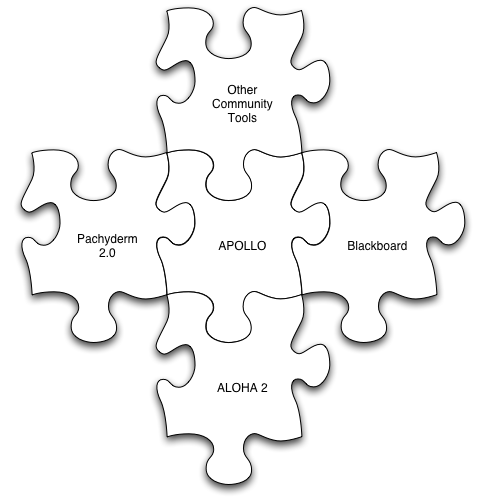
Perhaps the easiest way of thinking about these projects is with APOLLO acting as a kind of malleable glue that can hold distinct and separate technologies together. We see things like ties to Blackboard LMS happening somehow via APOLLO, which can serve as a bridge between any of the other project puzzle pieces.
Read MoreScott Leslie Describes His APOLLO Plan
Scott Leslie is heading up a rather large initiative in BC to deploy some cool whiz-bang learning object technology across the province for a couple of very large organizations. His group recently made a decision on which technologies they were going to use, and they picked APOLLO.
Scott has written up an excellent description of his rationale, plan, and hopes for the BC/APOLLO collaboration. I really like his pragmatic stance - use what’s best for the job, and for the users. He likes Open Source, but isn’t married to it. He likes commercial software, but will use something else if it’s a better fit.
Read MoreNMC 2004 Session Decentralist Manifesto Random Notes
- Even a decentralist wants a system to work
- Provide the wires and power and let it go
- Provide the interfaces
- Decentralists are not de-connected
- not isolationsists
- not vandals
- community based on a shared platform
- rapid group forming, ridiculously easy group forming and problem solving, group comes together and disappears when the need is gone
- ad hoc!
- kind of like affinity groups from Henry Jenkins keynote
- don’t have to stay together forever
- don’t define ourselves in terms of communities, define ourselves in terms of ourselves
- we can use the best available tools whenever we want
- need to post our manifesto on the wiki
- centralists are like IT
- centralists keep power flowing, WiFi working
- what are great successes that we can cite
- scientific discovery is decentralized
- great art is decentralized
- web is decentralized
- The centre will not hold
- University of Calgary still only supports Netscape 4.7
- decentralism is Darwinian, 1000 will be culled out, some will survive
- the more centralized, the more standards get lower
- the Dodge Caravan ads hammer the message join the team
- decentralists think!
- D’Arcy: “could have gone down hill but it didn’t”
- Brian, D’arcy, Alan met after doing a presentation on RSS, blogs and Wikis
- decentralized collaboration works
- decentralized, virtual collaboration requires a different skill set than real world face to face collaboration but the skillsets are complementary
Thank you to Small Pieces contributors!
The NMC 2004 Small Pieces session yesterday went extremely well (I think ;-) ) - it was very chaotic, noisy, confusing, loud, and messy, but I think it was interesting or at least entertaining for all.
There was activity on the wiki, some on the weblogs, and some iChatAV video conferences. The Decentralists group wound up too deep in a very compelling discussion to break away for iChatAV. Our discussion turned into one of the most vibrant and engaging experiences I’ve had in quite a while (thank you Decentralists!)
Read MoreLessons learned from Weblogs.com fiasco
Here are some lessons that I learned from the whole Dave Winer weblogs.com affair.
- Own you own domain name. If your blog is at your own domain name, then if you are using a hosted service and somebody takes it down, you can move your content without breaking links.
- Keep backups of everything that is hosted by everybody else
In the long run, it will be so easy to host your stuff, that you will rather than having to worry about other people taking down your stuff. Decentralists rule long term!
Read MoreGetting ready for NMC 2004 Road Trip
The Norman family is just about ready for the big trek across the Rockies. We’re heading to Vancouver for NMC 2004 Summer Conference, then across to the Island for a few days before returning home.
As a result, things are likely going to get quiet(er) around here. I’ll likely be blogging something from the NMC 2004 conference, but aside from that, I hope to be completely offline for the week following the conference.
Read MoreGetting Ready for Small Pieces Loosely Joined Session
Well, we’re about an hour away from the Small Pieces session at NMC 2004. There has been a surprising amount of interest from people in the hallways, and some actual traffic on the weblog and wiki.
My gut tells me this may go exactly one of two ways, either:
- Raving success
- Confusing chaotic failure
My vote is currently on the first one (I think this is going to be fun for all involved, too), and I’m hoping that the real meat of the session shifts away from the tools themselves and into the somewhat contrived discussion we’ve tried to set up.
Read MoreDecentralists win long term aka I am an NMC 2004 Fencesitter
See my post at:
Decentralists_ Rule in 10_years or_so AKA I am an NMC 2004 fencesitter
for why
Read MoreExperiments in collaborative weblogs
I’m trying a little experiment over on the Decentralists Weblog for the NMC 2004 Summer Conference.
The weblog can be edited via the web, and is password protected. I’m going to try it for a while with a public password, so folks can add/edit content. I’m not crazy. I’ve backed it up so if things go south I can restore it pretty quickly.
Flame-retardant suit is handy, just in case…
Read More