Drupal is aimed at making it easy to publish and manage a website right out of the box. Its main goal is getting content online, without providing many restrictions on who gets to see it (you can turn off guest access to all content, or for some specific content types, but there isn’t a native “audience” defined for content).
There are a whole bunch of really cool modules that add this additional functionality. Organig Groups lets users define their own groups on the fly, making it easy to discover content published to a group. Simple Access lets you define which roles get to see/edit/delete content. Taxonomy Access lets you define which roles get to see content tagged in a specified taxonomy/keyword. Etc… The list goes on and on. Lots of great access control modules, each doing different things to manage access to content according to various workflows and scenarios.
Brian ’s finally getting back to blogging, after being dragged to the other side of the planet and back. He knocks one out of the park with this one.
So I too use Wikipedia as a nexus for discussing all manner of digital effects. Sure, you have to acknowledge some shortcomings, but I’ll stack the benefits against the liabilities any day. And when, as is almost inevitable, someone asks “what do you think of students citing Wikipedia in an academic essay?” I simply shout back “what do you think of someone citing Britannica? Huh? HUH?” and glare at them a bit. That usually shuts them up, and shutting people up is the hallmark of authoritative instruction.
I’m trying out Zooomr - it’s a photo sharing site similar to Flickr, but with some cool new features like Lightboxes and Inspectors. It’s lacking all of the communities and contacts that keep me coming back to Flickr several times per day, but they’re doing some cool things at Zooomr.
Not only does Zooomr drop the “e” in “er”, they also throw in an extra “o” or two. These silly Web 2.0 names are getting to be a pain, but what are they going to do, with all “normal” domain names taken long ago?
It’s a pretty good read (so far) and touches on issues that aren’t unique to Drupal. But, it’s nice to see Drupal getting some Big Corporate Loving™
Much of the articles are spent describing necessary customization for making Drupal sites behave nicely. Dries Buytaert (the lead of the Drupal project) hints that good news is in the works…
The stampede parade starts in a few minutes, so it’s officially Stampede Season. The Canadian Forces just buzzed the UCalgary campus with what sounded like a CF-18 - I couldn’t see it, but that’s the only thing it could have been. They have one down on the grounds for display - having to drive it through city streets at 2am the other night to get it downtown. It would have been kind of surprising to look in your rear view mirror, and see a CF-18 pulling up behind you…
I was thinking I’d start hitting the wall as the week progressed, but I’m still riding, and feeling better. I thought I’d be feeling pretty dead by Thursday, but this morning’s ride was a new personal best, and I feel great.
The only thing I’m a bit concerned about is the weather. Supposed to get thunderstorms this afternoon. That would suck if it hit while riding. Not the end of the world. I’ve been wet before. Better to get soaked on the way home, than on the morning commute…
A quick tour of the NMC Second Life campus. I walk around the virtual poster session, go for a walk/fly, and take a quick look around. Click the “play " or “download " links to take the tour.
The poster session seems odd at the moment - I’m not sure faithfully reproducing the physical world is the best way to take advantage of the virtual - but it may seem better on July 12 when the presenters will be on hand for discussion.
I had been making a case to attend OSCON2006 this year, the logic being that it’s a better fit for what I’m doing now than WWDC is. OSCON is a gathering of open source projects and programmers/developers, with tracks on various cool open source technologies, methodologies, etc… WWDC is a corporate developers conference, aimed specificially at core Apple technologies (with some obvious trickle-over into open source as well).
The sub-thought was that I could save some coin in our budget by going to an open source conference, rather than a high-end corporate one.
I was just clearing out the last of the comment spam - I’d let it stew in the database (unpublished) but thought I’d take a quick peek to see if there were any false positives. I thought I’d found one - a comment marked as spam, but with content portraying sympathy with my plight against these spammers - that they must be stopped.
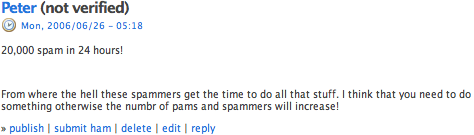
A Spammer Responds (screenshot): This spam roach was trying to get whitelisted by commiserating on the evils of spammers… It didn’t work - Akismet sniffed it a mile away.
Last year, Flickr was offering some cool free stuff to help promote the site. There were stickers and buttons showing the Flickr logo and the famous Flickr Dots.
They ran out, promising there would be “… more good stuff” - and now, a year later, there’s still nothing.
I mean, come ON, Flickr. I’d pick up an official Flickr shirt (polo or T), a baseball hat, and some other stuff… Doesn’t have to be free, but where’s the goods?
The spammers started trailing off not long after I wrote the previous post - before hitting their target of 20,000 spam attempts in 24 hours. They punked out at about 18,000 - then I closed the door with the Bad Behavior module.
It was kind of interesting leaving the spammers swarming around my blog as a honeypot, but the load was just getting annoying. Since enabling Bad Behavior, Akismet has had to deal with less than a dozen spammers getting through in about 24 hours - and I haven’t had to deal with (or even be aware of) any of them. That’s a wee bit of a change…