D'Arcy Norman, PhD

Recent Posts

Notes: Coulthard, M. (1974). Approaches to the Analysis of Classroom Interaction

Coulthard, M. (1974). Approaches to the analysis of classroom interaction. Educational Review. 26(3). pp 229 - 240.

On directing discourse:

Participants with equal rights and status, as in everyday conversation, negotiate in very subtle and complex ways for the right to speak, to control the direction of the discourse and to introduce new topics. We therefore determined to reduce the number of variables by choosing a situation in which one of the participants has an acknowledged right to decide who will speak, when they will speak, what the topic of the discourse will be, and the general lines along which it will progress. The classroom was an ideal situation.

Read More

unplugging third party trackers

I’ve been crafting a fine tinfoil hat in response to thinking more about pervasive third party tracking. And I realized I had been a total hypocrite since I was still running Wordpress.com stats on my blogs. Even though it was “anonymous,” it adds to the pile of third-party data that is tracked for online activity. I’ve now disabled tracking from Wordpress.com stats - and with that, I think, there are no third party trackers tied to my blogs. There could be something through a plugin or something, but nothing I’ve added.

Read More

WSJ on web trackers

The Wall Street Journal has been on a roll, looking at privacy online. The [latest article looks at the trackers, bugs, beacons, and cookies](http://blogs.wsj.com/wtk/) used by various websites to monitor you (and then share that data). For example, the simple site dictionary.com tracks a fair bit of data about visitors:

Screen shot 2010-08-04 at 11.22.37 AM.png

***234*** activity trackers. To look up the definition of a word.

Read More

Notes: Garrison, D. Online Community of Inquiry Review: Social, Cognitive, and Teaching Presence Issues

Garrison, D.R. (2007). Online community of inquiry review: Social, cognitive, and teaching presence issues. Journal of Asynchronous Learning Networks. pp. 61-72.

from abstract:

>The early research in the area of online communities of inquiry has raised several issues with regard to the creation and maintenance of social, cognitive and teaching presence that require further research and analysis. The other overarching issue is the methodological validity associated with the community of inquiry framework.

Read More

WSJ on nuking privacy for profit

The Wall Street Journal took a look at the trackers (cookies, beacons, etc...) used by advertisers to track activity and connect various bits of data (what movies you like, what websites you go to, what music you buy, etc...)

They claim that the data they store is anonymous.

The information that companies gather is anonymous, in the sense that Internet users are identified by a number assigned to their computer, not by a specific person's name. Lotame, for instance, says it doesn't know the name of users such as Ms. Hayes-Beaty—only their behavior and attributes, identified by code number. People who don't want to be tracked can remove themselves from Lotame's system.

Read More

Notes: Vaughan & Garrison: Creating cognitive presence in a blended faculty development community

Vaughan, N. & Garrison, D.R. (2005). Creating cognitive presence in a blended faculty development community. The Internet and Higher Education. 8(1). pp 1-12.

This study compares face-to-face and online discussions in a professional development course on blended learning. Specifically looking at the three forms of presence as defined as part of the community of inquiry model (but with an emphasis on how participants move through the 4 phases of the inquiry process (triggering event, exploration, integration and resolution) as part of their cognitive presence)

Read More

Googlethink - displaced agency through the cloud

>Software programmers are taking the displacement of personal agency to a new level. Relentlessly focused on making their programs more "user friendly," they're scripting the intimate processes of intellectual inquiry and even social attachment. We follow their scripts when we click on one of Google's keyword suggestions, and we follow them when we select from a list of categories to describe ourselves and our relationships on Facebook. These choices are convenient, but they're not our own. They're generalizations masquerading as personalizations.

Read More

networked

I ran [EtherApe](http://etherape.sourceforge.net/) on my Ubuntu Server system for about 45 minutes this afternoon, sniffing network connections on the office LAN. Nothing snoopy/creepy, just network addresses and protocols. Man, there are a LOT of machines involved...

The node at around 10 o'clock is my desktop Mac.

EtherApe diagram

Read More

irrational objection to the wild, wide open?

[Stephen responds](http://www.downes.ca/cgi-bin/page.cgi?post=52960) to my previous [post on classblogs](https://darcynorman.net/2010/07/22/on-private-classblogs-vs-the-wild-wide-open/):

> My first reaction (as I'm sure it is for many) is that we shouldn't compel them to do anything. But when you ask the question in the context of formal education, you begin to see how ridiculous it is. Is there anything in education that isn't compelled? Participation is enforced to the age of 18, college and university courses typically have requirements for graduation. So why should public performance be any different? And - it isn't! We require singers and actors to perform in public in order to graduate. Lawyers stand in moot court. Interns perform in actual hospitals, apprentices in real garages. Graduate students are frequently reminded that they should have some journal publications to their name. So why the objection to publishing on the web? It's an irrational objection, when compared with the practices we see everywhere else in education.

Read More

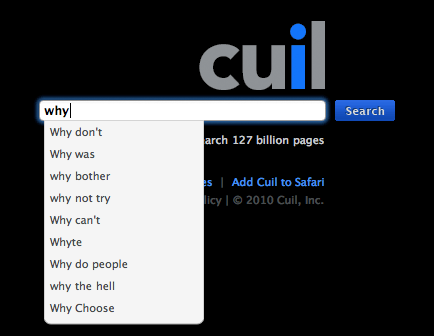
why

Screen shot 2010-07-26 at 2.04.45 PM.png

good questions, indeed...

other search engines take a stab at the meaning of life:

Screen shot 2010-07-26 at 2.08.38 PM.png

Screen shot 2010-07-26 at 2.09.29 PM.png

Screen shot 2010-07-26 at 2.10.22 PM.png

Screen shot 2010-07-26 at 2.12.12 PM.png

Read More

Anthony Bourdain on the modern panopticon

In Medium Raw, Bourdain describes the thoughts he had, transitioning from a coke-head heroin addict to a doting father, and how the panopticon (he didn't call it that, though) played a role in the process:

NewImage.jpgThe iniquitousness of Twitter and food- and chef-related Web sites and blogs has totally changed the game for anyone with a television show - even me. You don't have to be very famous at all these days to end up with a blurry photograph on DumbAssCelebrities.com. You don't want your daughter's little schoolmates reading about her daddy, stuttering drunk, two o'clock in the morning, at a chef-friendly bar, doing belly shots from a chunky and underdressed cocktail waitress – something that could well have happened a few years ago. In a day when a passing cell-phone user can easily get a surreptitious photo of you, slinking out of the porn shop with copies of Anal Rampage 2 and MILFBusters under your arm, and post it in real time, maybe that's a particularly good time to trade in the leather jacket for some cotton Dockers.

Read More
Mastodon