D'Arcy Norman, PhD

Recent Posts

Antti Oulasvirta on reforming CHI

I'm new to the CHI community, and have been involved with only one project that submitted a paper to CHI. I was struck by the cadence - it's a once-per-year submission deadline that sets the pattern of activity for an entire research lab. That feels weird. Maybe it's good, though, as it pushes people to publish their work on a regular basis rather than just at the end of a thesis or dissertation project…
Read More

NSERC application – Baxter+ study

This hurt. A lot. The scores showed this submission was the weakest academically of the 97 NSERC applications written by UCalgary PhD students, according to the committee. Ouch. It also scored very poorly for ā€œresearchā€ – but scored well for ā€œinterpersonalā€. So, Ms. Congeniality. Awesome. I, like, totally am all about world peace and junk.

I think the results show a couple of things.

  1. the local UCalgary NSERC committee doesn’t get the kinds of things CMD thinks about. Good data. Won’t likely try for NSERC funding again. SSHRC is likely a better fit. This proposal didn’t make it past the initial sniff test. I have no idea how the national NSERC committee would have received it. It didn’t fit into a known bucket, so got punted at the first chance.
  2. I need to take more ownership over shaping my research agenda. I proposed the Baxter follow-up study because it was shovel-ready, but it wasn’t directly related to the kinds of things I’m thinking about. I need to follow my own path, and do so boldly.

So. Next year, I’ll try for SSHRC funding for part of my refined research plan, rather than just pushing an existing project.

Read More

Kyle McDonald - A Return to Machine Learning

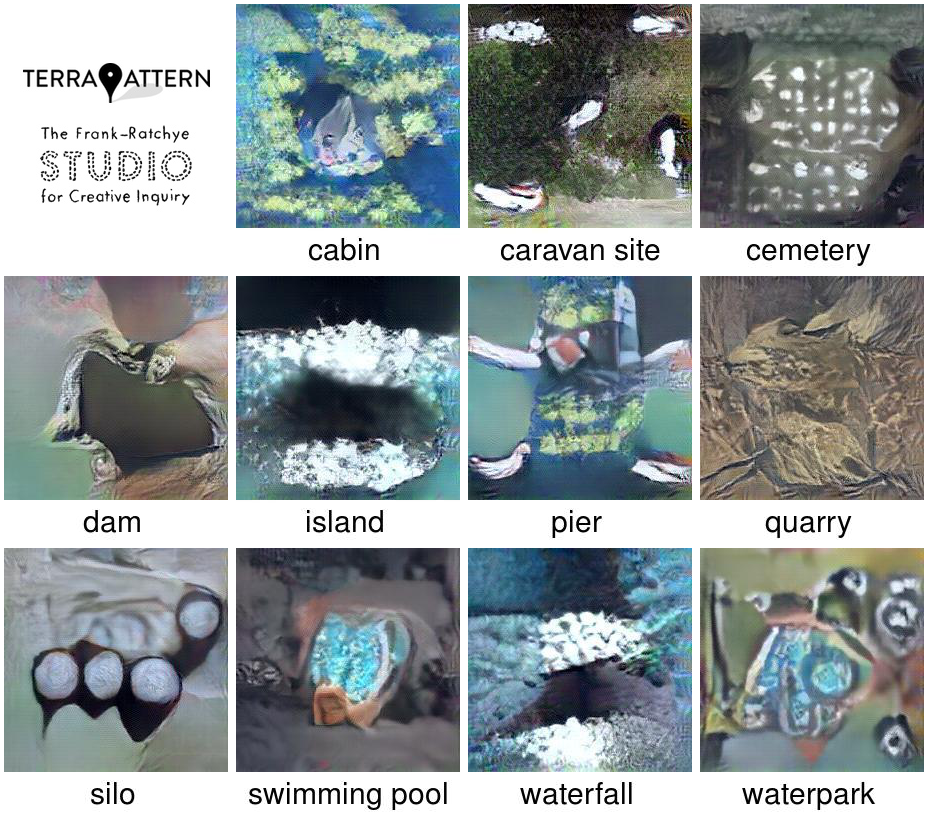
A crazy/deep overview of some of the amazing developments in machine learning in the last couple of years, especially as a medium for artistic expression and exploration.

This last year I've been getting back into machine learning and AI, rediscovering the things that drew me to it in the first place. I'm still in the "learning" and "small studies" phase that naturally precedes crafting any new artwork, and I wanted to share some of that process here. This is a fairly linear record of my path, but my hope is that this post is modular enough that anyone interested in a specific part can skip ahead and find something that gets them excited, too. I'll cover some experiments with these general topics:

Read More

Quincy Larsen: Live asynchronously

We've been adapting to life in a shared, open workspace environment. Most of us in the Taylor Institute are in pods, trying to balance productivity, collaboration, distractions, competing demands for attention. It's hard to describe what it's like, but it adds overhead on top of everything. Quincy describes it well, from the perspective of s programmer, but I think it applies to the rest of us as well.

Let's talk a bit about how us humans get work done. Is it four hours of crushing it, a lunch break, then four more hours of crushing it? No. It's more like coffee, email, coffee, meeting, coffee, lunch with coworkers, coffee — OK finally time to get some work done!

Read More

Computer science researchers create augmented reality education tool | UToday

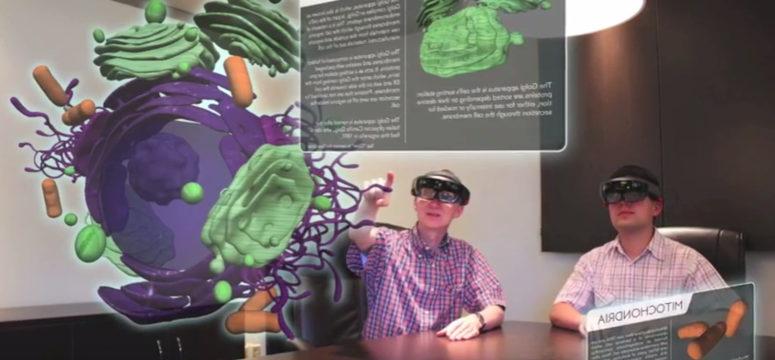
This is cool. Christian's lab has been producing some amazing tech for visualizing and interacting with human and cellular anatomy, including LINDSAY Virtual Human, and now this:

Christian Jacob and Markus Santoso are trying to re-create the experience of the aforementioned agents in Fantastic Voyage. Working with 3D modelling company Zygote, they and recent MSc graduate Douglas Yuen have created HoloCell, an educational software. Using Microsoft's revolutionary HoloLens AR glasses, HoloCell provides a mixed reality experience allowing users to explore a 3D simulation of the inner workings, organelles, and molecules of a healthy human cell.Jacob has plenty of experience in bioinformatics as the head of the Lindsay Virtual Human Project.

Read More

University Affairs - Classrooms are getting a makeover to accommodate new forms of teaching

University Affairs article on active learning classrooms, with a bit about Michael Ullyot's Shakespeare course in the Taylor Institute:

He's taught courses in a similar way in regular classrooms using workarounds to deal with obstacles such stationary chairs and more rudimentary technology. "You can do this in just about any classroom, you just need enough imagination," he says, adding one stipulation: "If I had a banked lecture hall, this would not work."

Read More

on disconnecting to think

I'm in the third week of a PhD program, and have had to make some adjustments to how I do things in order to be able to concentrate and actually think. I was struck by my inability to read a full paragraph without switching over to check email/calendar/twitter/slack/facebook/whatever. Mostly email and twitter.

I'm basically living in digital content - everything I do is in OneNote and Outlook, synced to every device I use. My email and calendar basically organize my day. There are people in there.

Read More

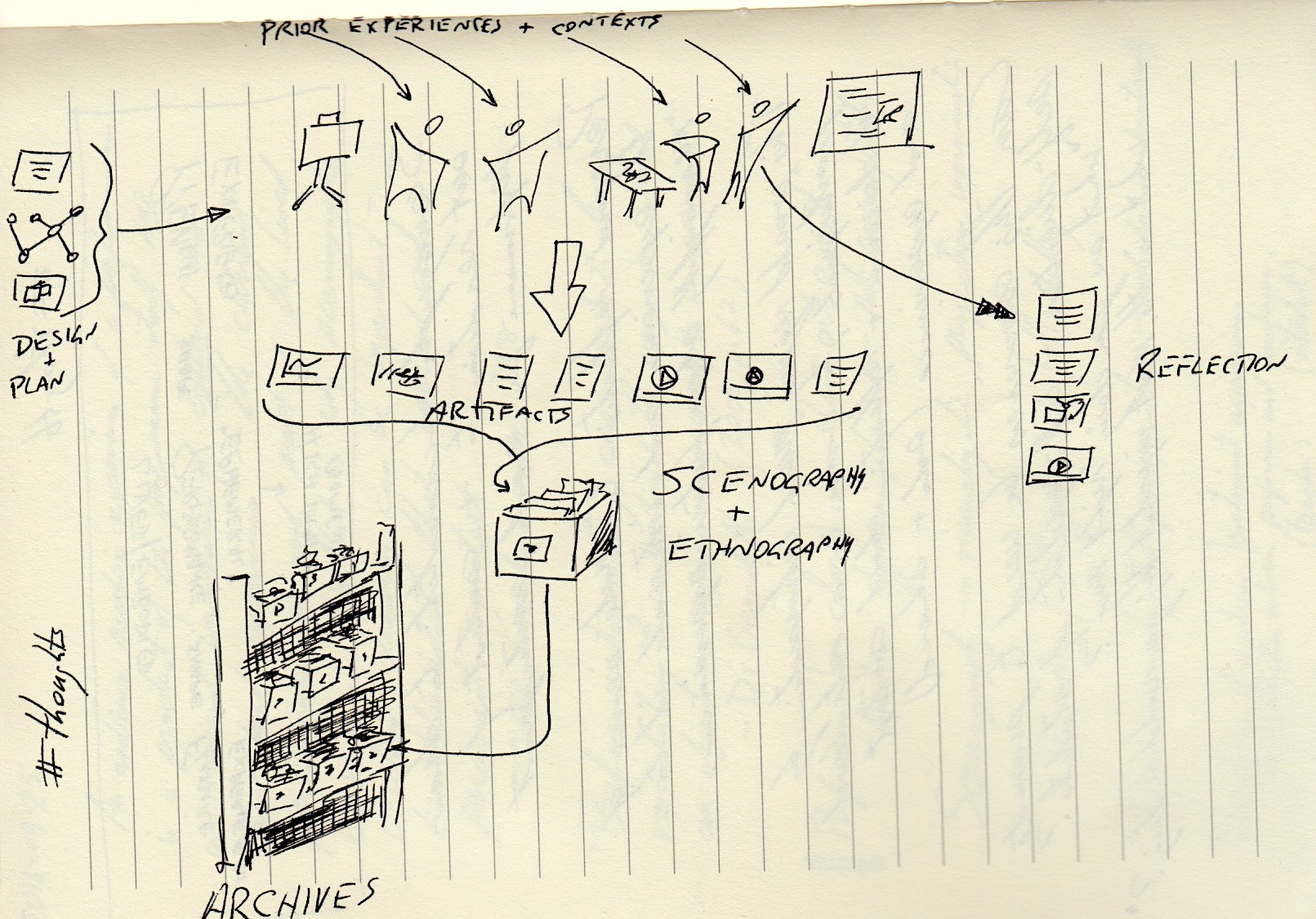
performance as research data

  • who is performing?
  • in which roles?
  • activity vs. passivity, static vs. dynamic
  • what do the performers bring as background? the audience/participants?
  • what is actually happening during a performance?
    • what was planned?
    • what was perceived?
    • what are the lasting marks?
    • what are the high impact moments?
      • what makes them high impact?
  • archives & historical data?
    • design + planning
    • recording + documentation of event
    • recording + documentation of subject responses
  • is evaluation of the performance useful?
  • how to foster/support meaningful reflection? (for all participants)
  • how to make sense of energy + interactions?
  • can a recording / analysis of a performance have greater utility than the raw/live performance?
  • how to record/interpret sensory perceptions?
    • visual/auditory/haptic/olfactory/… of each participant?
    • why would this be recorded? what purposes would these data serve?
Read More

thoughts on documentation and interpretation of an experience/class/session

interpretation-of-experience

Are teacher/performer & student/audience synonymous?

(How) are all of these data + interpretations to be used to shape the current experience and future ones?

(How) can these be generalized to other contexts?

So what? Why is this useful? – Not just scholarly navel-gazing?!

How do these support meaningful + productive reflection by instructors and students?

Read More

research methods discussion + reflection

  • Check-in
  • Action items from previous meeting
    • Schedule meeting times (doodle poll in progress)
    • Approve approaches to documentation of informal progress (blog, meeting notes, comments and questions about program)
    • Begin work on methodology for grant
    • Begin work on research methods reading material
    • Finalize readings from SoTL and CompSci (coming ASAP from ES & NC)
  • DRAM 605 – weekly meetings to discuss readings and test ideas toward SSHRC proposal
  • Having a conversation about the nature of language in sharing (text/material) (online/publicly)
  • CMD PhD weekly meetings –
  • Reflective practice based on research – constantly testing the work
  • Next meetings
    • Discuss intro to each methods book
    • Teach the intro chapter
    • 3 hours every Monday, 1 with PF
    • DRAM 605 – meets Monday afternoon 2-5pm
  • Grant application – Who do we apply to? NSERC? SSHRC?
Read More
Mastodon