I spent a few days at HESA’s AI-Cademy at UBC’s main campus this week. This is an attempt to step back and figure out what themes emerged from across the pre-conference and 2 days of the conference proper. This isn’t comprehensive because I had too many pages of notes from all sessions to do a full session-by-session conference post. (yes, I used Claude to help crunch through my many many pages of notes to pull out the key themes across sessions. If I hadn’t, I’d have taken me weeks to write this and it would have been all I’d be doing in my spare time, so yeah. cognitive offloading.)
Last year’s AI-Cademy was mostly about institutional posture: policies, governance, how fast to move. This year there was more talk about what AI does to thinking and learning, and what institutions are for. A handful of ideas kept coming up in sessions that otherwise had little to do with each other.
Thinking becomes optional
The line that stuck with me came from the Day 2 plenary on cognitive surrender: “AI allows thinking to become optional.” The speakers added a “System 3” to Kahneman’s fast and slow thinking, for cognition handed off to AI. Thinking is expensive and people take shortcuts when they can, so of course this is going to get used. They were worried about deskilling, and also about “never-skilling,” where students never develop a skill in the first place.
They also cited a Georgetown study of university application essays. Before AI, applicants had different ideas written in similar language. After AI, they had similar ideas written in varied language. That kind of sameness is hard to notice because the writing itself looks varied.
Students know this is happening. Waterloo’s study found students worried about relying on AI and “getting stupider.” They trust its output somewhere between 50 and 80% of the time, and about one in eight have never used it.
Looking at process
If you can’t tell from an essay whether a student wrestled with it or handed it off, the essay isn’t much evidence of learning anymore. Most presenters ended up arguing for paying attention to process: having students document how they worked, reflect on it, and make that visible to the class. Zimmerman’s self-regulated learning cycle came up in at least two talks.
Institutions are trying different things. UBC Sauder labels each assessment as either AI permitted with attribution, prohibited in a controlled setting, or required. UBC has a testing centre where students book a time to write exams. Yorkville uses oral defences. They all have limits. Oral defences are great with twelve students and hard to picture with 300, and process documentation can turn into a checklist pretty quickly.
Waterloo also found that AI is making students suspicious of each other’s work, and 68% of them want the university to police AI use. They also said they want clear policies, and they don’t want a ban.
The apprenticeship gap
The future-of-work fireside chat made the point that entry-level work is how people learn the ropes, and that’s the work AI is taking over first. If AI is doing that work, it isn’t clear how anyone becomes an expert.
The cognitive surrender session used airline pilots as an example. Pilots have to log manual flying hours before they’re allowed to use autopilot, and their use of it is limited after that. That works because aviation is heavily regulated. Most disciplines, and most of higher ed, have nothing like it.
The same fireside chat suggested that double-checking AI’s work isn’t a good use of staff time. I get the efficiency argument, but if nobody does the work and nobody checks it, I’m not sure who’s left who can tell when it’s wrong.
That matters for the ways people were proposing to divide up work. MacEwan’s ARC model has the instructor design a course (Architect), AI build it out (Render), and the instructor test and adjust it (Calibrate). A QA team found 93% agreement between human and AI program audits. AI looks capable at the middle step. Calibrating takes expertise, though, and that’s the thing getting harder to build.
AI for what?
During the presidents’ panel I wrote “AI IS NOT THE GOAL” in my notebook, in bigger letters each time. It’s a tool. The question is what we want to use it for, and I didn’t hear many clear answers. It’s a means to an end, not the end in and of itself.
The strategic planning advice was useful, though. Anchor the plan on values instead of specific technologies, don’t lock it into a five-year window, figure out how you’ll measure progress, and keep it a living document. UBC’s answer to how they do innovation at scale was “we fund it.” Amii suggested small, low-risk projects so junior leaders can practice before the big ones, and said higher ed has “gotten away with not being intentional.” Fair.
Someone also said from the stage that technology is neutral. No. It isn’t. (Paging Audrey Watters…) Tools carry the assumptions and business models of the people and companies that make them, and that’s worth remembering when the tool is designed to do your thinking. It’s interesting, hearing AI experts who believe that technology is neutral. That kind of colours everything else they migth say…
Grades
The thing I kept coming back to was grades.
A grade is a measurement, and it’s a comparison. Its job is to put a student’s work on a scale so it can be compared with other students’ work, which is what makes GPAs, scholarships, and admissions function. It also means a course ends up being about producing things that can be ranked. That’s had side effects for a long time. Students chase the grade instead of the learning. Failing is costly, so they avoid risks. Classmates become competitors.
AI makes each of those worse. If the grade is what counts, offloading the work is a reasonable decision. One plenary asked how students can learn from failure when AI makes it impossible to fail, but grades had already made failing too expensive. When students are ranked against each other, a classmate using AI is a threat to your standing, so I’m not surprised Waterloo’s students are suspicious of each other and want someone to police it. And if we start grading process instead of products, students will learn to perform the process.
Someone at last year’s AI-Cademy said “The system has always been broken. AI just made it impossible to ignore that.” Grading is a big part of that. We’re not going to drop grades next term, since credentials, accreditation, and transfer depend on them. We could be a lot more deliberate about what gets graded, how much rides on it, and whether feedback needs a mark attached. People have been working on this for years with ungrading, specs grading, competency-based approaches, and low-stakes formative work. If we leave grading alone, our AI policies will keep working against incentives we built ourselves.
The VPTL panel
I was really looking forward to the U15 VPTL Panel, as it would have been a good opportunity to hear Yakut speak at a conference. Unfortunately, she was unable to present and I was asked to fill in for her on the panel. I think it went pretty well, and am hoping I didn’t step in anything that will cause problems… Regardless, it was a great opportunity for me to work with Gavan, Nancy, and Karsten, and we had a fun conversation in front of 500 of our closest friends.
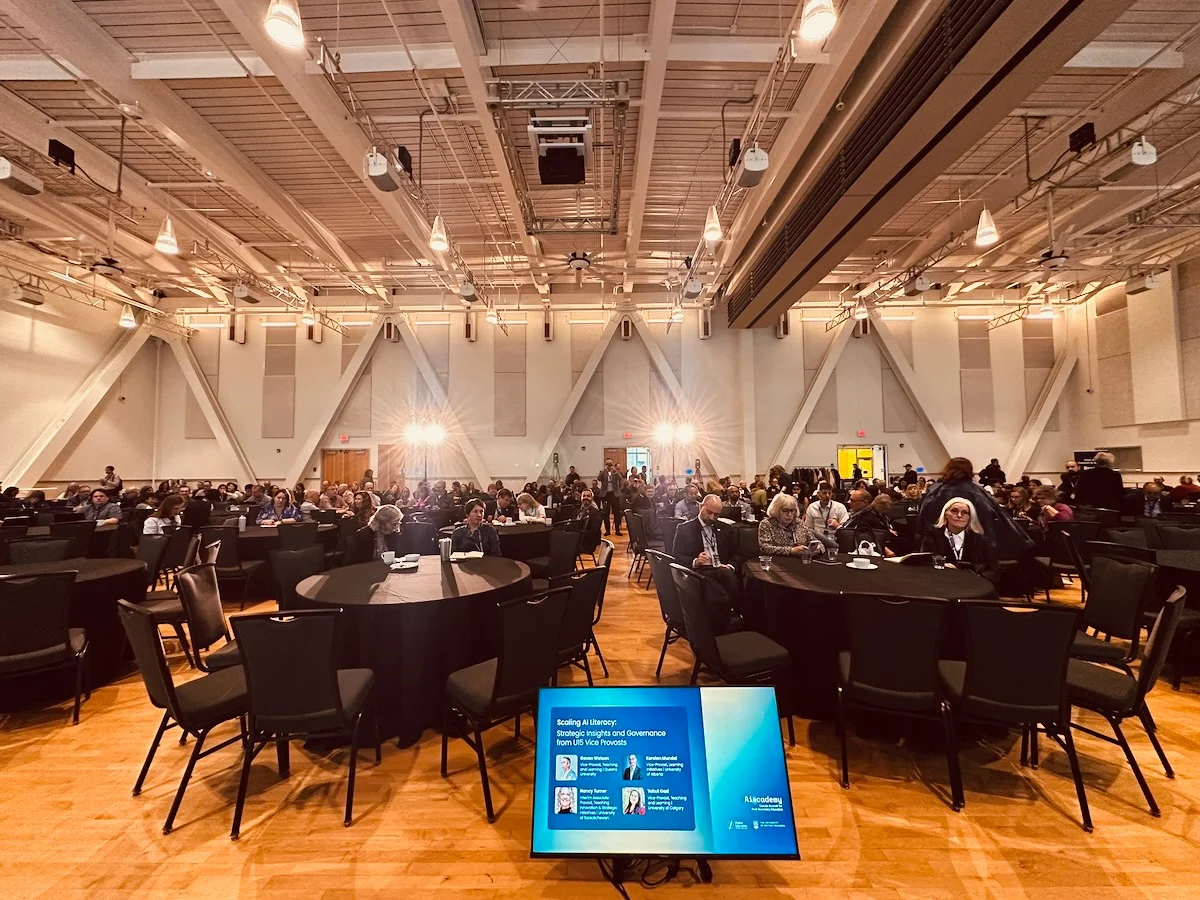 The view from the stage in the Great Hall, a few minutes before the session started
Still thinking about
- What process-focused assessment looks like in a 300-seat first-year course, without turning into surveillance.
- Who’s responsible for the “autopilot hours” when there’s no regulator.
- How much of what we grade actually needs a grade.
- What my own institution’s answer to “AI for what?” is, and whether our strategy starts there.