I had the honour of co-chairing this year’s conference with Natasha Kenny. It was an incredibly rewarding experience, and I learned so much from being able to work with all 3 keynote presenters. The conference theme was centred around exploring digital transformation in postsecondary education:
From Disruption to Connection: Digital Transformation in Postsecondary Education
From the conference theme:
Digital transformation in higher education is here. Change is happening more rapidly than ever. GenAI is transforming assessment practices; traditional academic structures and programs are shifting to further meet learners’ needs; how, where, when and why we learn and communicate has expanded. With each new wave of change comes a familiar tide: an ebb and flow of concern and optimism about what this could mean for the future of postsecondary teaching and learning.
Each new disruption offers an opportunity to renew relationships and focus our efforts on a core principle of education—the importance of connection. Pedagogical and organizational shifts highlight the importance of fostering community, flexibility, and belonging in teaching and learning. In these times especially, we must cultivate relationships grounded in respect, reciprocity, care and curiosity.
It took a little longer than expected, but the recorded keynotes are available now (except for Dr. Eaton’s, due to some technical issues that were not anticipated.)
Dwayne Donald and Anahi Palomec McKenna
On the emergence of meaning: Knowledge experiments that honour relational renewal
This session will bring focus to the colonial logics of relationship denial as it relates to possibilities for meaningful educational transformation. We will frame knowledge experiments as sustained opportunities for people to experience knowledge and knowing in unique ways and find meaning through attending to the wisdom of relational renewal.
What a masterful demonstration of students as partners in the design of courses, and Anahi brilliantly shared her experience as one of Dr. Donald’s students. Dwayne and Anahi were generous in sharing their personal perspectives, and on connecting their work to the conference theme. The first keynote really set the vibe for the entire conference.
Sarah Eaton
Postplagiarism: Ethical, Equitable, and Inclusive Learning Futures
The rapid rise of generative artificial intelligence (GenAI) and related technologies have disrupted traditional notions of teaching, learning, and assessment in higher education. In this keynote, Dr. Sarah Elaine Eaton shares her award-winning postplagiarism framework as a way of understanding educational integrity in an era where technology cannot be decoupled from education. Postplagiarism provides us with a way to move beyond historical definitions of plagiarism and detection-based approaches, reframing integrity as a shared responsibility grounded in ethics, equity, and human dignity.
As always, Dr. Eaton gave a deeply engaging and richly evidence-based overview of a better way to look at academic integrity, especially in the age of generative AI tools. What happens if we move beyond adversarial approaches designed to catch cheating, and toward one that centers student learning and agency?
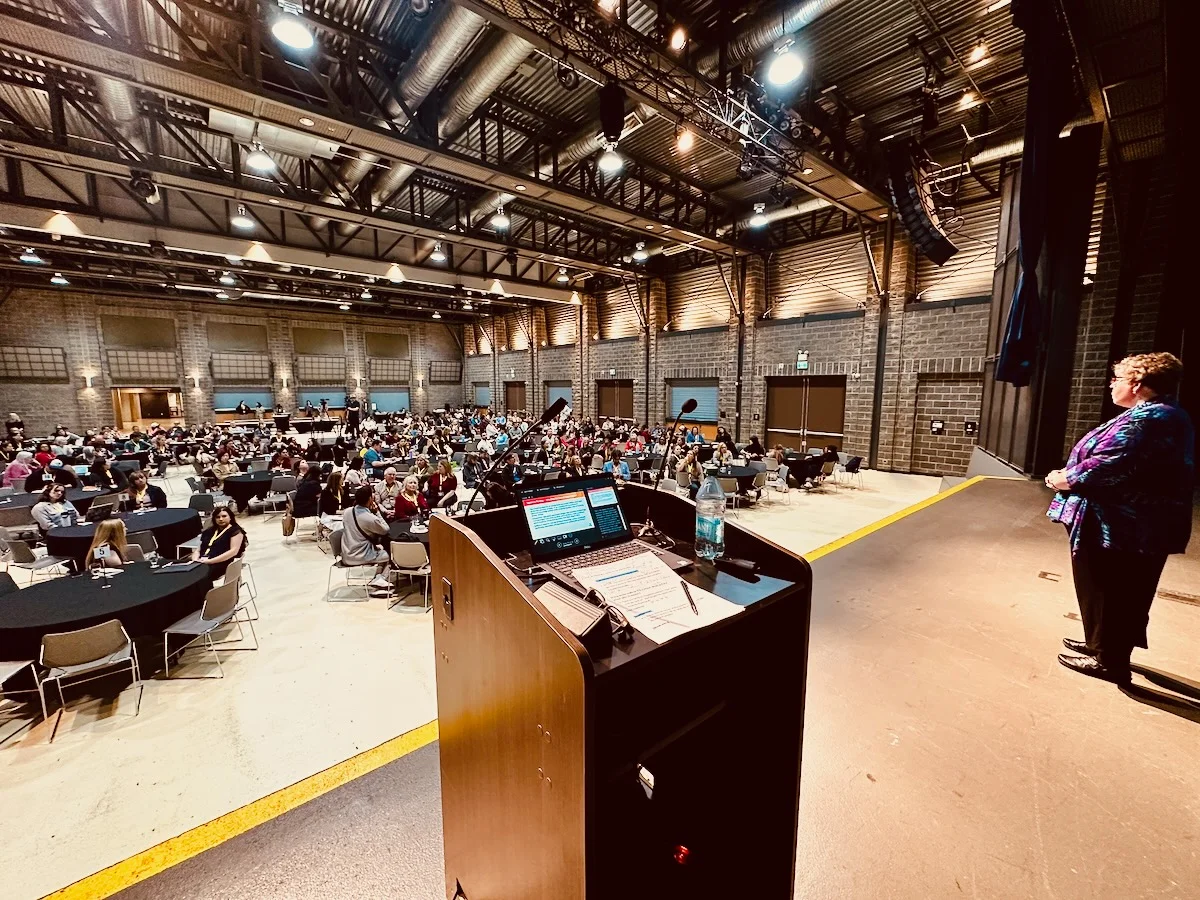
sarah eaton keynote
A large conference or convention center filled with attendees seated at round tables, with a speaker standing at a podium on stage and industrial brick architecture with steel beam ceiling visible overhead.
Photo by D'Arcy Norman
(There were technical issues that prevented Sarah’s keynote from being recorded as planned, so this photo will have to suffice…)
Anne-Marie Scott
Technology is the Easy Part: Enabling Digital Transformation
Colleagues who are charged with leading digital transformations in post-secondary institutions right now have some of the hardest jobs out there. Trying to support an institution to chart a course between wild enthusiasm and deep concern and reach some sort of consensus on action that does more than achieve “status-quo with a twist” is a hard task at the best of times, and this is not the best of times by any stretch. In our times of heightened financial pressure here in Canada, digital technologies can present us with substantial opportunities, but they are not transformative in and of themselves, because they do not exist separately to people and culture. Investing in creating the right kind of enabling environment is key to understanding that technology is actually the easy part, and any “digital transformation” is ultimately a people and culture transformation.
Wow. Anne-Marie was ON! Authentic, incredibly well-informed, generous, authentic, and funny!
And, wow, what an incredible call to action. What an incredible entangled collection of calls to action. Anne-Marie shared concrete examples of how collaboration and sharing has fostered local development and agency, and how the Commonwealth (literally the machinery of historical colonialism (my words, not hers)) is now an important part of enabling education around the world. Her examples of how “large project funding is easy but small funding is hard” and of leveraging institutional resources to enable small-scale innovation will inform important aspects of our work.
And, her recognition that teaching and learning is built upon all roles at a university, not just faculty members, and how the staff that enable teaching are essential in the process, was timely and needed. It also prompted some reflection of my own, given how in recent writing I’ve somehow glossed over the importance of all roles (despite, you know, cough, leading a team of staff members who support instructors across the university…). Which connects to Dwayne’s keynote and the role of Paradigmatic Provocations…